Sunday, August 28, 2016

The Coldest Girl in Coldtown by Holly Black


    1. Summary: Tana wakes up in a bathtub following what must have been an epic party only to find out that everyone else who was there is dead and her ex-boyfriend, Aiden, is possible going to turn into a vampire. Her past tells her to get to a Coldtown, a walled city-within-a-city that houses both vampires and lovers of them, in hopes of saving herself and her friends. Along the way she falls in love and wrestles with her own mother’s infection and eventual death at the hands of her father to save Tana’s own life. Inside Coldtowns, people are literally dying to be part of a hollywood style society, filled with power and danger.
    2. Textbook: Despite the fantasy world of vampires and a world where they are revered, as well as feared, this novel still has characters that feel real. Tana is a high school girl who ends up in extreme situations but always keeps her head on straight and the drive to help others and stick together are both familiar topics in life. The world full of Coldtowns still has universal rules and expectations, making the idea of a life with these circumstances feel very real despite the fantasy elements. There are bounties for turning in these dangerous creatures, government funding and regulations for Coldtowns, and schools teach students the basics of vampirism and what to do in the case of a potential infection.

 Black, H. (2013). The coldest girl in Coldtown. Little, Brown Books. 


Other books by Holly Black:


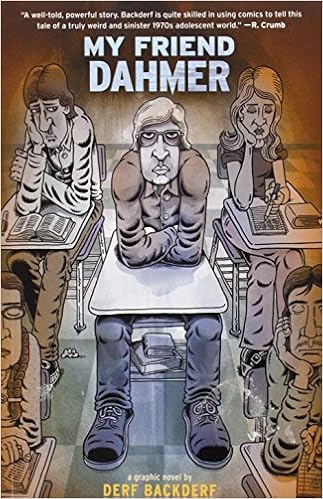
My Friend Dahmer by Derf Backderf


    1. Summary: Jeffery Dahmer was known as “Jeff” in high school. He was an odd guy who kept to himself, but also managed to become part of Backderf’s group of friends for comic relief purposes. Little did anyone know that his extremely dysfunctional home life, crippling and dangerous thoughts, and anxiety would overwhelm him, drive him to drinking, and eventually turn “Jeff” into the notorious serial killer Jeffrey Dahmer. The small town he spent his life in and the people who walked the same halls as him were turned upside down when his killings became public. But despite his oddities and crimes, Backderf portrays Dahmer as a victim of his mind and not wholly the evil he became.

 Backderf, D. (2012). My friend Dahmer: A graphic novel. New York: Abrams ComicArts. 


    1. Textbook: Not only is this a great piece of nonfiction, but it also uses the form of a graphic novel to portray the strange happenings of the life of Jeffrey Dahmer. The author, Derf Backderf, is a highly credible author as he walked the halls with Dahmer and included him in his circle of friends and some activities. He witnessed his spiral into depression and alcoholism, as well his odd behaviors and eccentricities. His facts are correct and he incorporates his own research on events he was not part of to accurately tell the story of Dahmer. In regards to this being a graphic novel, colors are kept monochromatic with black and white as the only colors throughout the story. The textbook discussed the ability of graphic novels to reveal mood and tone, and this novel portrays the balance or lack off between good and evil in Dahmer’s life.


Teaching Ideas for My Friend Dahmer (high school students only)
#1
Lesson/Assignment:  In small groups after reading about Dahmer's life in high school and knowing what he did after he graduated from high school, come to a consensus as to if the author was trying to gain sympathy for Dahmer by writing the book or not.  Be prepared to support your theories and ideas using the book.  If your group cannot reach a consensus, give support for both theories.  Share your results using Powtoons, Haiku Deck, Smore or Powerpoint.

#2
Assignment:  Use your knowledge of the people, feelings and events in My Friend Dahmer to add text to the drawing on page 14. (A copy of the page will be provided) Choose a perspective- Dahmer's, Backderf's or a neutral narrator.  Use thought balloons (Dahmer) or captions above or below the drawing to clarify or expand on what the art is showing in the drawing. What is happening? What emotions are going through Dahmer's mind?
#3
Assignment:  Jeffrey Dahmer was an alcoholic teenager. Research the affects of teenage drinking.  Include the following:  Average age a teen begins drinking, how it affects school work, family life, and sports.  Include behavioral changes involved with alcoholism.  Use such sites as www.cdc.gov, pubs.niaaa.nih.gov, and www.webmd.com.  Create a Prezi, Powerpoint, or Haiku Deck to share your findings. Work individually or paired partners.  Presentations will be presented in class.
#4
Assignment:  What adjectives come to mind when you think of different parts of the novel? Are the words 'dark'? Find 15 adjectives that support a sentence you create related to the novel.  For example, the word 'menacing' could be used to describe Dahmer. 
#5
Assignment:  This assignment is a reflective piece.  After reading the novel, write how you feel about it.  Has the book saddened or frightened you or made you angry? Should Backderf have written the novel, or just kept his story to himself? Backderf makes comments that no one at school or home helped Dahmer.  What should the school have done when they noticed the changes in Dahmer? Should they have intervened? What about his parents? Do you think they were neglectful? If so, in what ways? Your reflective essay should be a minimum of 3000 words, double spaced. 
Lesson plan reference:
Holmes, R. (2015, July 14). My Friend Dahmer [Web log post]. Retrieved August 28, 2016, from http://robinsreadingideas.blogspot.com/2015/07/my-friend-dahmer-how-would-you-feel-if.html

Speak by by Laurie Halse Anderson


Melinda, a high school student filled with anger and hurt, must confront the demons of her past as she starts a new year. Her friends have abandoned her and the evil that haunts her mind lurks through the hallways with a wink and a smile. An unoccupied janitor’s closet becomes her place of refuge as her grades began to fall and her anxiety grows. Everyone is angry that she called the cops the night of the big party and no one believes her when she says she was raped. But Melinda grows in confidence and knows the truth will come to the surface to save her.

 Anderson, L. H. (1999). Speak. New York: Farrar Straus Giroux. 

Speak embodies the characteristics of realistic fiction by being set in a high school and having characters who represent today’s teenagers and the struggles they go through as they navigate the exciting and sometimes dangerous roads of the teenage years. Rape is a very taboo topic that isn’t discussed enough in regards to young adults. This novel not only addresses the situation and how a young woman can overcome this hellacious event in her life, but also the issue of seeing young men who have positions of popularity in society as not being capable of doing horrible things. No one believed Andy could do what he did until it almost happened again for people to see.


Speak Book Trailer