Sunday, October 30, 2016

The Notorious Benedict Arnold by Steve Sheinkin


  1. Beginning with the hanging of a traitor, we are guided through the life of Benedict Arnold, beginning with this tumultuous childhood, which included the death of sisters and his father’s decline as a merchant and increasing debt. Arnold eventually joins the military and then the New Haven Militia when Britain begins taxation without representation. He becomes a colonel, helps capture Ticonderoga, but isn’t given the credit due. His next journey leads him to try and conquer Quebec. The journey through the wilderness fails initially, but he holds up in a blockade and is promoted to General by Washington. He continues to fight for America, but when his successes are again not recognized, he forms a pact with John Andre to surrender Fort West Point to the British. Their plan is discovered, Andre is hung, and Arnold flees to London.
  2. Textbook: Sheinkin’s writing background includes textbook writing and fact checking, giving him the credibility to write a nonfiction story about Benedict Arnold. His focus is on telling the true story of Benedict Arnold, but in a way that engages young people to read about history. This text is divided by time periods and the people who cross Arnold’s path as he moves from American hero to traitor. At the end of the novel, there are extensive source notes, quotation notes, and even an index to help readers locate specific information about the text. Although there aren’t any graphics within the text, the cover is incredibly important: the image of Arnold standing tall, but with his face shadowed pulls readers into the text by making it look like an adventure novel.

Sheinkin, S. (2010). The notorious Benedict Arnold. New York: Macmillan

Monday, October 24, 2016

Code Name Verity by Elizabeth Wein


  1. In part 1, Julie, code name Verity, is a British spy during WWII who is captured by the Germans when she is forced to eject from the plane she is in over France. She is forced to tell her story and reveal British secrets to the Nazis, but instead uses her writing to tell the story of her best friend and pilot, Maddie, as well as embed the secrets of her mission. Maddie’s pilot journals become the basis of part 2. Maddie was able to crash land the plane she was flying and takes up with a resistance group called Damask. One of Julie’s interrogators goes rogue and switches sides, taking Julie’s paper with them to Damask. Maddie is able to decode the mission, as well as make plans to save Julie. But, things go awry and Maddie is unable to save Julie. Fearing she will be tortured or reveal information, Julie kills her friend to save the secrets.

  1. Powerful female characters stand out in this great piece of nonfiction. Placed in a time period when women weren’t given certain opportunities, even when it came to war, Julie and Maddie defy society’s ideas of what women can do. In addition to the positive female characters, the themes for this historical fiction are very prevalent for today’s readers. Friendship is a central theme that drives the plot and keeps the reader engaged, even when the awful ending occurs  and a friend has a to kill a friend for the sake of the war. In addition to friendship, perseverance and honesty are also dealt with. Young readers deal with these life lessons and sometimes don’t have positive examples of dealing with pressures.

Wein, E. (2013). Code name Verity. New York, NY: Hyperion.

Thursday, October 20, 2016

Feed by M. T. Anderson


  1. Summary: Titus and his friends decide to head to the moon for a spring break trip. Visions of wild parties fill their minds, but instead, half the places they want to go are long gone. While at The Ricochet Lounge, Titus meets Violet, the most beautiful girl he has ever seen. After some initial jealousy by the girls in the group, Violet is welcomed into the crowd and they head to another club. Out of nowhere, an old man shows up and essentially hacks their feeds, which are internal, supercomputer, social media like functions that keep them surrounded and controlled by media. To fix their feeds, they must be turned off. This is a struggle for Titus because he is used to being constantly connected. Violet and Titus stay friends and she reveals that she didn’t receive her feed until she was 7 and that it is malfunctioning. This eventually leads to her becoming brain dead and despite Titus ditching her earlier, he essentially becomes her feed, keeping her connected to her past.
  2. Textbook:  Dystopian fiction has been extremely popular the last few years with the rise of The Hunger Games and other dystopian series. This particular novel focuses on the dangers of being constantly bombarded with media of all forms, from advertisements to social media. The constant noise has kept them controlled by corporations and numbed them to the realities of the control and the reality of their world crumbling around them. Although I believe teenagers should read this as a cautionary tale in regards to the dangers of constantly being connected, I honestly think they will disagree with parallelism of their own lives to the characters in the novel.

Anderson, M. T. (2002). Feed. Cambridge, MA: Candlewick Press.


Looking for Alaska by John Green


  1. Summary: Miles wants to get away from his friendless, uninteresting life at his current school and decides that attending the same private school his father did is a great way to find his Great Perhaps. Once he arrives, he meets the Colonel, Alaska, and Takumi, all juniors like himself. They are all about pranks at the school, and he manages to get in with the top pranksters. After being hazed by other students, his group avoids the Eagle, the dean of the school, and goes on a pranking war. After their pre-prank of putting blue hair dye in kid’s shampoo, they spend the night drinking and celebrating. Alaska suddenly bolts and says she needs to get out, so the Colonel and Miles pop fireworks as a distraction for her. Unfortunately, she dies in a car crash when she leaves and her friends are left to mourn her and try to figure out what happened and how to get out of the labyrinth of life.
  2. Textbook: This novel is a great example of teenage realistic fiction, although I feel like not all students would be able to identify with the private school atmosphere. I know for my students the idea of leaving the public school life is something they could never imagine. But, they can absolutely identify with Miles’s desire to fit in, to be loved and wanted by a girl, and the crushing loss of one of his best friends and thinking he was to blame. Guilt is a heavy theme in this novel that far too many young adults deal with these days. Miles, the Colonel, and Takumi all suffer guilt due to Alaska’s death; Alaska feels guilt and shame for not calling 911 when her mother passed out and died. The way they handle their guilt is a lesson for young readers: do you embrace the guilt, realize some things can’t be helped, and move on? Or, do you let the guilt rule your life and run you into the ground?


Green, J. (2005). Looking for Alaska. New York: Dutton Books.

Sunday, October 16, 2016

Annie on my Mind by Nancy Garden


  1. Summary: Liza is an outsider at her school who finds solace in museums. One day, she runs into Annie, who intrigues her from the beginning, but she doesn’t seem to know why. She feels different around Annie, but doesn’t quite know why. They are from different sides of town with different family histories, but they are drawn to one another, soon falling in love. Liza questions her sexuality throughout the entire novel, but when they are given the opportunity to spend the night together, all things are confirmed. Annie has known for a long time that she is gay, but Liza isn’t so quick to make that statement. But after their tumultuous night together, which ended in Liza’s lesbian teachers being fired for their sexual orientation, she realizes she knows what real love is, and for her, that love is with Annie.
  2. Textbook: Written in 1982, this novel was groundbreaking in its focus on a teenage lesbian relationship. This novel was written when this topic was incredibly taboo, and to be completely honest, is still taboo when it comes to teenagers. Some reviews have said that today’s teen would see this novel as cheesy, but I disagree. I think teens would be surprised at the timidness of their relationship because today, their love affair would be wild and edgy. This novel is truly about love and not just about sex, which I believe is what made this novel so powerful. More importantly, this piece investigates the mind of someone exploring their sexuality, and especially the pressures and confusion that comes with it.

 Garden, N. (1982). Annie on my mind. New York: Farrar, Straus, Giroux.

The following is a link to other novels similar to Annie on My Mind

Period 8 by Chris Crutcher


  1. Summary: Period 8 is a place where everyone can relax and be themselves in the crazy world of high school. Mr. Logs is their fearless guide, who always helps them work through everything they are going through, like when Paulie confesses to his girlfriend Hannah that he cheated on her with Mary Wells. Their relationship has crumbled, but things get even stranger when Mary Wells goes missing and Arney Stack, the “honest” student council president, slides in on Hannah. Soon, Mr. Logs, Paulie, and Hannah realize that Mary Wells has been abducted, her father is involved, and Arney is a total psychopath trying to kill Mary, and soon, Hannah as well.
  2. Textbook: Chris Crutcher is known for his YA novels focused on teenagers dealing with real life issues in real life settings. He doesn’t disappoint here, although he moves into an area that isn’t typical for all students: being kidnapped by a psychopath. Crutcher keeps his characters and their situations consistent with teenage life; from their teen speak, to the focus on sports as a release and teenage heartbreak. This novel, besides addressed every day teenage issues like cheating, teenage friendships, sports, it also addresses the dark side of life: liars, killers, psychopaths, twisted cops, and deranged parents. I enjoyed the complexity of Paulie; he seems just like a meathead jock in the beginning, but his true character and heart is revealed over the course of the novel.

 Crutcher, C. (2014). Period 8. New York, NY: Greenwillow Books.


Saturday, October 15, 2016

The Knife of Never Letting Go by Patrick Ness


  1. Summary: Todd Hewitt and the dog he never wanted, Manchee, live in Prentisstown. This is a town of men and he is the only boy left. There is constant Noise, the thoughts of every man in the town, floating around for everyone to hear. Right before his 13th birthday when he is poised to become a man, Cillian and Ben, his caretakers since his mother’s death, tell him he must leave. With very little instruction and a quickly packed rucksack, Todd and Manchee leave everything they’ve ever known to quickly learn everything was a lie. Viola, a girl from another world, becomes his drive to survive as they run from a crazed army of Prentisstown men who want to capture Todd and take over the world.
  2. Textbook: This novel would fall into the realm of fantasy/science fiction. Prentisstown is a place where a germ has caused everyone to hear everyone else's thoughts. But despite the unbelievability of this, when Todd realizes that he can read Viola’s thoughts without hearing them, the read is able to trust in this world. It isn’t different from the pastoral time periods that humans have experienced. People left their homelands to find new and peaceful places, but were sometimes faced with great challenges and difficulties that they either overcame or that caused them to fail. The descriptions of the other communities and the lack of formal knowledge in comparison to Viola’s world where technology and formal education were critical is in direct comparison with the city versus country beliefs on education: learning to hunt or learning geometry? Also, as the story progresses, we learn the truth about Prentisstown and the laws of the New World, which further solidify the trust that readers have in these two teenage characters and their world.

Ness, P. (2008). The knife of never letting go. Cambridge, MA: Candlewick Press.

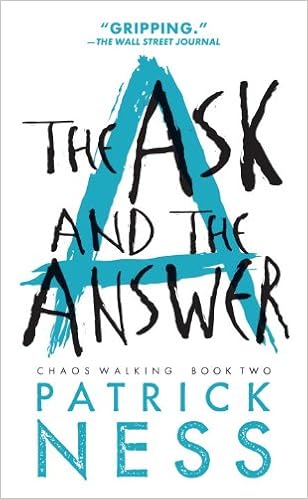
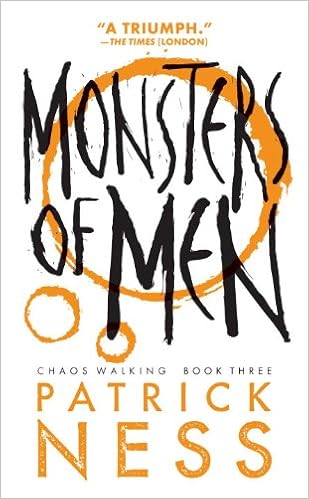
Other books in the Chaos Walking series:


Wednesday, October 12, 2016

Monster by Walter Dean Myers


  1. Summary: Steve Harmon is just a teenager when he is charged with the murder of a drugstore clerk in Harlem. It is alleged that he was the person who was sent into the drugstore to determine if any police were present, and if not, to give the all clear. Daily, he writes in his journal thinking about what he is being accused of and how his life will turn out if he is sentenced to prison, all while listening to the horrors of prison from his cell. His lawyer is afraid he will be guilty by association and urges him to take the stand and prove he doesn’t associate with the others charged. Between his testimony and the testimony of Mr. Sawicki, his film teacher in high school, Steve’s character is saved and he is found not guilty of murder. This novel is told through the lense of a film script because he was out and about scouting places for his next film for class when he became a suspect for this crime. Also, his own journal entries from his cell provide insight into his emotions, his internal feelings, and his slow downfall into feeling like he will be found guilty despite his known innocence.

  1. Textbook: This award-winning novel encapsulates current events and situations, despite being published in 1999: crime in traditionally black neighborhoods and the demise of the black male being surrounded by the gang culture. This novel brings to light the issues of guilty by association. Just because Steve is a black male who was seen around the drugstore where a murder was committed, he is grouped into the circle of criminals. The reader believes that Steve is innocent even when he begins to believe the lies he hears in prison that someone will be found guilty, even if they aren’t. His mother brings the underlying theme of racism to light with the statement that people thought she should have hired a black lawyer instead of the white, female lawyer, addressing the fear that Steven would not be properly defended because of his race. But, the themes in this novel don’t smack the reader in the face or overtly point out racism and bigotry; instead, those themes are carefully revealed and wrapped up when Steven is found not guilty and is able to return to his teenage life and bright future.

Myers, W. D., & Myers, C. (1999). Monster. New York, NY: HarperCollins.


Monday, October 10, 2016

The Absolutely True Diary of a Part Time Indian by Sherman Alexie


  1. Summary: Arnold Spirit, better known as Junior, lives on the Spokane Indian Reservation in Wellpinit and his life is far from simple. His parents are alcoholics, his sister is a runaway, and his best friend is incredibly angry. Arnold was born with fluid on the brain which has caused him great trauma as a child: seizures, a larger than normal head, and daily beatings by people on the reservation making fun of him. After he throws an ancient geometry book at Mr. P, he realizes, with Mr. P’s help, that the only way to escape his dismal, reservation future is to move to a non-reservation school 22 miles away. Reardon is all white and he is far from white. But soon, he begins to fit in, becomes a freshman starter on the basketball team, and even falls in love with a girl named Penelope. He feels regret and blames himself for tragedies that occur after he changes school, including the deaths of his grandmother and sister. But soon, despite the pain, he realizes he has done the right thing and has finally broken the rez cycle.
  2. Textbook: This piece of realistic fiction is different from the other selections due to its focus of Native American culture, more specifically reservation life. The reality that reservations are sad places of death and alcoholic destruction is something that Americans don’t want to address. If they acknowledge it, it must be true. Despite revolving around a culture and history that many students would not know or understand, readers can identify with Arnold’s need to fit in with people, please his family, break a vicious cycle, and  do all of these things without abandoning the only life he has ever known. Like Gabi: A Girl in Pieces, the cultural influence doesn’t override the universal themes and characters. This novel also includes small elements of a graphic novel by including drawn images depicting scenes from the novel, supposedly drawn by Arnold himself. These don’t fill the pages of the novel, but they definitely enhance the themes of the novel, as well as bring to life some of the iconic scenes.

Alexie, S. (2007). The absolutely true diary of a part-time Indian. New York, NY: Little, Brown.


ESL Audiobook and Full Text of Novel

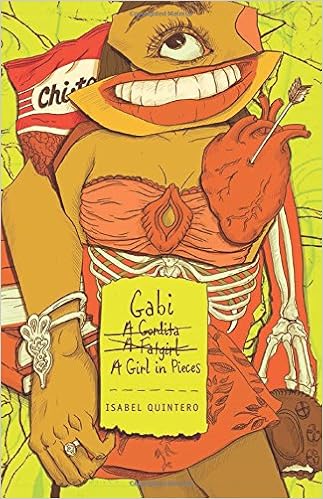
Gabi: A Girl in Pieces by Isabel Quintero


  1. Summary: Gabi’s life has always been fractured. Her father is a meth addict, her mother puts up with him, her brother tags walls with graffiti, she is overweight, and one best friend is gay and the other is a pregnant teen. She has loved her whole life dealing with the pressures of being a Hispanic female who wants to break free from the cultural constraints and go to college, but daily deals with the guilt of abandoning her mother. Soon, after years of drugs, her father dies in their garage and her mother becomes pregnant with her 3rd child. Gabi deals with her feelings through poetry (and a lot of food), falls in love and lust a few times, and finally realizes that her life isn't perfect, but it's her life and it is exactly what it should be. She gets into her dream school and recognizes that she will always be part of her hometown and her past, but those times don't define her future. 


  1. Textbook: This is the first book I've read for this class that addresses Hispanic culture, both its positives and negatives. Gabi is overweight, light-skinned, and according to her mother, incredibly disobedient. In reality, she is being held down by her mother’s cultural beliefs that Hispanic women should focus on their looks to get a good husband, should plan on staying home to care for their family and avoid leaving them for an education, and that “boys will always be boys,” thus are held to a lower standard of behavior. Realistic fiction addresses real issue. In this novel, teenage issues of homosexuality, teen pregnancy, religion, laws, education, rebellion, and family are all addressed. Gabi is an every man, a girl who deals with so many things that teenagers deal with that anyone can relate to her. I personally related to her concern over body image and being overweight, thinking I would never find someone who loved me for me. But Gabi overcomes them all, being a hero to teens who read this piece.

Quintero, I. (2014). Gabi, a girl in pieces. El Paso, TX: Cinco Puntos Press.


Wednesday, October 5, 2016

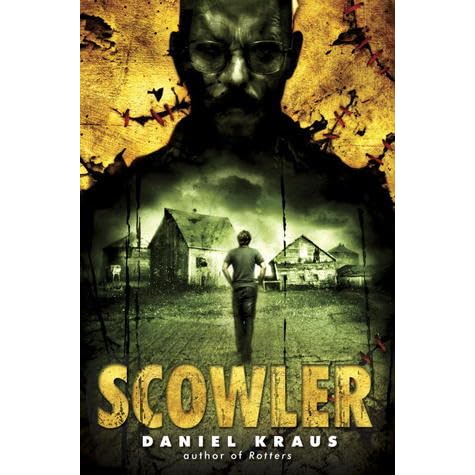
Scowler by Daniel Kraus


  1. Summary: Ry has lead very little resemblance to a normal childhood on his family farm. Instead of joy, his days were filled with abuse and mental torment by their father, Marvin Burke, as they worked side-by-side tending farm duties. One day, after Jo Beth, Ry’s mother, was caught again taking on sewing jobs for pay, Marvin decided to enact ultimate revenge: he sewed Jo Beth’s body to the bed, inch by inch. Ry knew something was wrong, and upon breaking into her room, slowly and precisely cut her free, both literally and figuratively. Ry was able to escape his father and save his mother and baby sister, Sarah, by relying on the Unnamed Three, toys that seemed to come to life and motivate him for both good and evil. Marvin goes to prison, but escapes when a meteor shower blows open a prison wall. He returns to his farm and tortures his family for days as he tries to carry a meteorite out of his farm land. The Unnamed Three come back to life to help Ry save himself and his family.
  2. Textbook: At first, this seemed like a realistic horror book. Small town, farming family who deals with a dad who gets off on torturing his wife daily. But with the emergence of the Unnamed Three, toys of Ry’s that come to life, speak to him, and help him overcome horrible circumstances. In addition to this very unrealistic occurrence, later we find out that Marvin has his own toy, Scalper Jim, came to life for him and fueled his gruesome crimes. Although this story walks the line of fantasy, once the reader recognizes that the toys coming to life is more like multiple personality disorder, the reader becomes connected to these suffering people, especially Ry, and sees a family in distress. The jumping back and forth of points of view reiterates this division of people and minds, elevating the chaos of their situation. Mental illness plagues this novel, but it isn’t appropriately addressed. Yes, Ry receives some help when dealing with the Unnamed Three; but not because he has a disorder, but more because his mother doesn’t know how to handle him. We also find out in the end that she didn’t burn them out of her own need to feel stronger than Ry’s psychologist.

 Kraus, D. (2013). Scowler. New York: Delacorte Press. 


Scowler Book Trailer