Tuesday, October 13, 2015

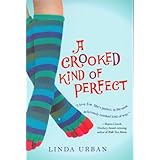
A Crooked Kind of Perfect by Linda Urban


All Zoe ever wanted was to play the piano, which of course would lead to playing at Carnegie Hall. But instead, she gets an organ from her father, who suffers from an anxiety disorder and doesn't leave home much. Her teacher sees her talent and enters her into a recital where she shows her new talent. Gaining friends along the way, Zoe learns that even with a path is changed, the journey down the path is what makes the end so sweet. 


 Urban, L. (2009). A crooked kind of perfect. Boston, MA: Sandpiper.


  1. Evaluation Criteria
    1. Gender and culture, as well as characters, are two criteria of contemporary realistic fiction for this novel. Zoe Elias is the opposite of traditional female characters: she is not only the protagonist in the piece, but she is also supported by male figures who experiences a weakness that wasn’t typically accepted in the past. Her father is the less dominant parent figure due to a social anxiety disorder that he suffers from. Along with  him, Wheeler, who seems like the tough guy at school, is able to show is more vulnerable side due to his parent’s divorce and lack of a father at home. These same characteristics produce unique characters that young readers can identify with, as well as see the “emotional growth” of all the characters involved.

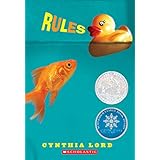
Rules by Cynthia Lord


Catherine just wants to be normal and for her brother, David, to follow rules like everyone else does. She feels weighed down by the fact that her brother is autistic, constantly fearing that he will embarrass her. But, through and unlikely friendship that is made at her brother's therapy sessions, Catherine learns that everyone is different and that learning to accept people's differences can be a pretty awesome thing. 


 Lord, C. (2006). Rules. New York, NY: Scholastic Press.


  1. Evaluation Criteria
This novel meets the criteria for contemporary realistic fiction through theme and setting. The “search for an independent identity” is exemplified in the complex relationship between Catherine and her brother, David. This search connects with young readers as many are experiencing the same quest. She wants so much to be separate from David’s complications, but realizes that he is PART of her identity. In regards to setting, Rules is set in an average town on a quiet, suburban street where kids meet for the bus together, swim in the lake during the summer, and become fearful of school dances. Young readers can both identify the characters as realistic in their setting, as well as transcend the setting to see themselves in the same situations.


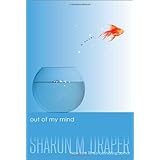
Out of My Mind by Sharon M. Draper


 Melody just wants to say all of the thing she has swimming around in her head like all the other people around her. After years of being so very different and alone, she is finally released from her own mind via new technology. But, just when she is finally being accepted for who she is, the harsh realities of the world knock her back down. 


Draper, S. (2010). Out of my mind. New York, NY: Atheneum Books for Young Readers. 


  1. Evaluation Criteria
    1. This novel meets the criteria for contemporary realistic fiction through the characters and plot. Melody is a non-traditional character who is not only female, but also has a disability. She is a female heroine and the underdog, both qualities that make the reader cheer her on through all of her struggles. As the reader travels through her trials and tribulations, the reader expects her rise to stardom and her new voice to take her to the top: the big quiz bowl. But, the realities of a society that doesn’t embrace different rears its ugly head, throwing the reader down a strange, new path. The plot also embraced the “hopeful, if not always happy” resolution of contemporary realistic fiction as Melody doesn’t get the result the reader hoped, but she does learn to live with what she has.

Wednesday, September 9, 2015

Primates by Jim Ottaviani and Maris Wicks


Informational text AND graphic novel? What better way to learn about three amazing women who, without formal degrees or really any training, paved the way for female scientific researchers and the study of primates. Jane Goodall, Dianne  Fossey, and Birute Galdikas's stories of tromping through jungles and closely observing their respective primates is both informational and appealing as presented. 

Ottaviani, J. (2013). Primates. NY: FirstSecond.

  1. Evaluation Criteria
    1. Style
      1. Presenting an informational text in the form of a graphic novel is incredibly appealing to young readers. It is sort of like combining a great picture book with a very well written non-fiction book. Beyond the author’s own style that is shown in regards to “distinctiveness in the presentation of the information,” the voice and attitude of the three women that the book tells the story of is very well presented. Their passion and strength is felt as the reader sees the comic book like images and reads the powerful words of their work. As the afterword stated, most of this book is true, but some is made up or altered, creating the fictional characteristics that help the book flow and help intrigue the reader to pick it up and continue to read it. This book is a great example of the “quality nonfiction that is just a worthwhile as a experience as a good novel.”


Tuesday, September 8, 2015

We are the Ship by Kadir Nelson


The history of the Negro Baseball league is sometimes trumped by its culmination in the form of Jackie Robinson. This book starts from the beginning of the league, providing quotes and commentary from players during the time to tell the story of the hardships of playing "America's sport" in a time when America was very much divided. Using powerful images to reinforce the emotions and situations of the time, this book reveals details of a very strained period in history through the love of baseball. 

Nelson, K. (2008). We are the ship. NY: Hyperion.

  1. Evaluation Criteria
    1. Organization
      1. This informational book is organized in “innings,” which both works chronologically for the information, but it also provides an extensive index if the reader is using the text more like an encyclopedia and simple wants to find information about one person or one event. Along with the main chapter titles, or “innings,” each chapter has a subtitle that briefly explains the type of information that is going to be included in that chapter. These “reference aides” let the reader both go in order of chapters, as well as jump around. Overall the organization “help[s] the reader to pick and choose what she or he needs;” in addition, there is a “clear sequence to the information” about the negro baseball league that will guide the reader through the book.


It’s So Amazing by Robbie H. Harris and Michael Emberly


The topic of where babies come from, what sex is, and what puberty is can be uncomfortable and complicated topics for parents to address. Through both scientific and child-friendly images, this book teaches children the facts about these very real and unavoidable stages of life. Great care is taken in the scientific terminology and graphics used to avoid the sexually-charged or incorrect language that children could hear from their peers. Instead, the focus is on education children on the science of the human body in an accessible and appealing way.

Harris, R. (1999). It’s so amazing. Boston, MA: Candlewick Press.

  1. Evaluation Criteria
    1. Design
      1. The design of this book both invites the reader to open it, as well as accurately informs the readers through visuals as they move through the text. The illustrations are all “appropriate and complement the text,” by making the very confusing, sometimes uncomfortable and unclear information regarding sex, birth, etc.very clear, concise, and informational. The images are painstakingly scientifically accurate, which “helps communicate the subject matter clearly and effectively.”

Tips for Parents

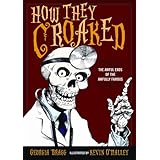
How They Croaked by Georgia Bragg


Did you know that Julius Caeser was tabbed by the people who were suppose to support him and Henry the VIII was left to rot in his room because no one had the nerve to inform the people that he had died? An interesting discussion of person's life can be told by starting with their death. In this intriguing book, the stories of famous people like Edgar Allen Poe, Albert Einstein, and Pocahontas are told with the focus being on their unique, and sometimes gory, deaths. Even if the reader thinks they know it all about these famous people, new details are revealed on every page. 

Bragg, G. (2011). How they croaked: The awful ends of the awfully famous. NY: Walker.

  1. Evaluation Criteria
    1. Style
      1. As the text states, an “author has his or her unique style or voice, and you look for that distinctiveness in the presentation of the information.” Bragg definitely exhibits a style all her own as she relays the information about the unique lives and deaths of famous people. To begin with, the illustrations are playful, yet dark in their colors and nature. The caricatures  of the famous dead people lighten the mood of this text about death. Also, the classic skull and crossbones and RIP’s remind the reader of the topic. Besides the illustrations, Bragg’s style can be observed in her syntactical choices. Although the text is fully informational, the language she chooses to use is of a light, friendly, youthful tone that can grab a young reader’s attention. The language is as if two young people were talking about the crazy deaths to each other. When Bragg talks about King Henry VIII “smelling like a giant rotten egg,” and that “some of his royal splendidness dripped out of the sides of the coffin overnight,” she creates very vivid imagery that very much appeals to youth readers.