Wednesday, November 2, 2016

Sweet by Emmy Laybourne


  1. Summary: Laurel and Viv have been best friends since the were kids. But as they’ve grown into teenagers, Viv has become more and more concerned with her body image. Viv’s father buys them both tickets to go on the Solu cruise, a cruise that’s goal is to showcase a new sweetener that guarantees weight loss. The host for the trip is a former child celebrity, Tom, who quickly falls for Laurel. As the cruise progresses, people begin to become addicted to Solu, turning them into vicious killers. People begin dying on the ship, but no one is stopping the distribution of the sweetener. Laurel and Tom join forces to save themselves and others on the cruise, including Viv who has succumbed to the addition. They soon find out that the creator of the sweetener new these things would happen and had masterminded the entire thing to rid the world of fat people.
  2. Textbook: This novel walks the line between modern realistic fiction and modern fantasy. The teenagers in the novel, as well as the focus on issues of teenage body image and young romance put the novel in the modern realistic fiction category. The characters mirror real life and that engages the reader and makes them feel like part of the story. But, as the story evolves and the Solu sweetener becomes an addiction, controlling people and forcing them to start killing each other and even drinking their blood to get the sweetener, fantasy elements begin to creep in. The idea of addiction is not far-fetched, but the movement from addition to practical vampirism is a stretch. The combination of elements keeps the reader involved in the story and the action carries through to the dramatic ending.

 
Laybourne, E. (2015). Sweet. New York, NY: Feiwel & Friends. 


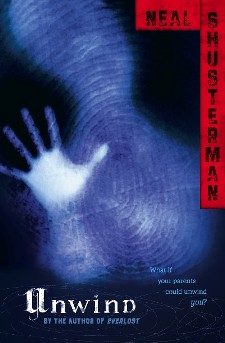
Unwind by Neal Shusterman


  1. Summary: Conner, Lev and Ria are all unwinds, teenagers turned over by their parents to the government to be chopped up and their body parts given to donors in need. They live in a society that now unwinds people in response to the number of abortions and unwanted children. Their deemed uselessness becomes incredible usefulness to people in need; people who need new limbs or organs. But they don’t go willingly; they fight for their right to stay whole by joining and underground railroad of sorts that gets to The Graveyard, a place of refuge until they turn 18. Through trials and situations, they are all saved from being unwound and eventually bring the issue of dismantling human beings to light and begin to force change in their society. Ria becomes paralyzed during an explosion at the Chop Shop, Conner receives a new arm after being injured, and Lev, who attempted to be a clapper, a suicide bomber of sorts, becomes an unintended spokesman for human rights.
  2. Textbook: This is a great example of scifi/fantasy. Despite living in a futuristic society, Rai, Lev, and Conner exemplify basic teenage qualities: brash, rebellious, hormonal, and willing to fight for what they believe in. The society they live in has glimpses of current society, even sometimes pointing out poor qualities of our society by addressing a futuristic societies response to the issue, such as an abortion and unwanted children. Either way, there are still concrete laws and ways of living in this society that are similar to current rules, allowing readers to understand the fantasy and believe it. The value of human life, the influence of religion, and the power of a person’s voice are all universal themes addressed in this novel despite being a novel set in a future time period and dealing with fantasy. This novel almost feels like a satire of our current society, but with a focus on teenage empowerment and other negative aspects of society.

 Shusterman, N. (2007). Unwind. New York, NY: Simon & Schuster Books for Young Readers.


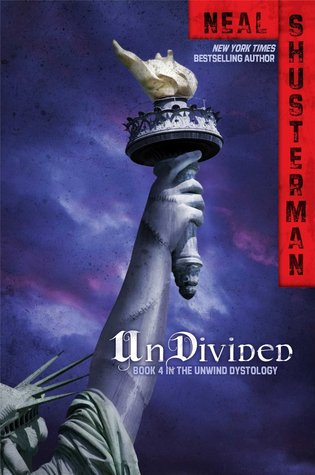
 Complete Dystology


Six of Crows by Leigh Bardugo


  1. This novel follows the protagonist, Kaz, and his band of criminals who try to pull off of a heist to free a scientist to get money that they all desperately need. His crew consists of Inej, Nina, Jesper, Wylan, and Matthias. Like any teen story, they all butt heads at first. Each character has their own unique backstory and strong opinions that create tension amongst the group. Throughout the novel, they band together to fight a common enemy and complete a heist in order to get paid. This illegal activity, ironically, brings them closer together due to the fact that most of them never had an actual family. Unfortunately, they are unsuccessful in their objective, but have learned a lot about themselves and one another. 
  2. This novel centers around the idea that friends can be a huge support system. This novel could be both a window or a mirror for readers depending on their upbringing, appealing to many audiences. Readers can either identify with the sense of abandonment and want for family, or they can peer into the world of street kids who are willing to do anything, including committing crimes, to make a little money to survive. Set in a world with magic with mystical languages, and stereotypical villains this piece of science fiction, creates a story that allows teen audiences to relate to the necessity of friendship and family.

Bardugo, L. (2015). Six of crows. New York: Henry Holt and Company


    2nd book in this Duology. 

Sunday, October 30, 2016

The Notorious Benedict Arnold by Steve Sheinkin


  1. Beginning with the hanging of a traitor, we are guided through the life of Benedict Arnold, beginning with this tumultuous childhood, which included the death of sisters and his father’s decline as a merchant and increasing debt. Arnold eventually joins the military and then the New Haven Militia when Britain begins taxation without representation. He becomes a colonel, helps capture Ticonderoga, but isn’t given the credit due. His next journey leads him to try and conquer Quebec. The journey through the wilderness fails initially, but he holds up in a blockade and is promoted to General by Washington. He continues to fight for America, but when his successes are again not recognized, he forms a pact with John Andre to surrender Fort West Point to the British. Their plan is discovered, Andre is hung, and Arnold flees to London.
  2. Textbook: Sheinkin’s writing background includes textbook writing and fact checking, giving him the credibility to write a nonfiction story about Benedict Arnold. His focus is on telling the true story of Benedict Arnold, but in a way that engages young people to read about history. This text is divided by time periods and the people who cross Arnold’s path as he moves from American hero to traitor. At the end of the novel, there are extensive source notes, quotation notes, and even an index to help readers locate specific information about the text. Although there aren’t any graphics within the text, the cover is incredibly important: the image of Arnold standing tall, but with his face shadowed pulls readers into the text by making it look like an adventure novel.

Sheinkin, S. (2010). The notorious Benedict Arnold. New York: Macmillan

Monday, October 24, 2016

Code Name Verity by Elizabeth Wein


  1. In part 1, Julie, code name Verity, is a British spy during WWII who is captured by the Germans when she is forced to eject from the plane she is in over France. She is forced to tell her story and reveal British secrets to the Nazis, but instead uses her writing to tell the story of her best friend and pilot, Maddie, as well as embed the secrets of her mission. Maddie’s pilot journals become the basis of part 2. Maddie was able to crash land the plane she was flying and takes up with a resistance group called Damask. One of Julie’s interrogators goes rogue and switches sides, taking Julie’s paper with them to Damask. Maddie is able to decode the mission, as well as make plans to save Julie. But, things go awry and Maddie is unable to save Julie. Fearing she will be tortured or reveal information, Julie kills her friend to save the secrets.

  1. Powerful female characters stand out in this great piece of nonfiction. Placed in a time period when women weren’t given certain opportunities, even when it came to war, Julie and Maddie defy society’s ideas of what women can do. In addition to the positive female characters, the themes for this historical fiction are very prevalent for today’s readers. Friendship is a central theme that drives the plot and keeps the reader engaged, even when the awful ending occurs  and a friend has a to kill a friend for the sake of the war. In addition to friendship, perseverance and honesty are also dealt with. Young readers deal with these life lessons and sometimes don’t have positive examples of dealing with pressures.

Wein, E. (2013). Code name Verity. New York, NY: Hyperion.

Thursday, October 20, 2016

Feed by M. T. Anderson


  1. Summary: Titus and his friends decide to head to the moon for a spring break trip. Visions of wild parties fill their minds, but instead, half the places they want to go are long gone. While at The Ricochet Lounge, Titus meets Violet, the most beautiful girl he has ever seen. After some initial jealousy by the girls in the group, Violet is welcomed into the crowd and they head to another club. Out of nowhere, an old man shows up and essentially hacks their feeds, which are internal, supercomputer, social media like functions that keep them surrounded and controlled by media. To fix their feeds, they must be turned off. This is a struggle for Titus because he is used to being constantly connected. Violet and Titus stay friends and she reveals that she didn’t receive her feed until she was 7 and that it is malfunctioning. This eventually leads to her becoming brain dead and despite Titus ditching her earlier, he essentially becomes her feed, keeping her connected to her past.
  2. Textbook:  Dystopian fiction has been extremely popular the last few years with the rise of The Hunger Games and other dystopian series. This particular novel focuses on the dangers of being constantly bombarded with media of all forms, from advertisements to social media. The constant noise has kept them controlled by corporations and numbed them to the realities of the control and the reality of their world crumbling around them. Although I believe teenagers should read this as a cautionary tale in regards to the dangers of constantly being connected, I honestly think they will disagree with parallelism of their own lives to the characters in the novel.

Anderson, M. T. (2002). Feed. Cambridge, MA: Candlewick Press.


Looking for Alaska by John Green


  1. Summary: Miles wants to get away from his friendless, uninteresting life at his current school and decides that attending the same private school his father did is a great way to find his Great Perhaps. Once he arrives, he meets the Colonel, Alaska, and Takumi, all juniors like himself. They are all about pranks at the school, and he manages to get in with the top pranksters. After being hazed by other students, his group avoids the Eagle, the dean of the school, and goes on a pranking war. After their pre-prank of putting blue hair dye in kid’s shampoo, they spend the night drinking and celebrating. Alaska suddenly bolts and says she needs to get out, so the Colonel and Miles pop fireworks as a distraction for her. Unfortunately, she dies in a car crash when she leaves and her friends are left to mourn her and try to figure out what happened and how to get out of the labyrinth of life.
  2. Textbook: This novel is a great example of teenage realistic fiction, although I feel like not all students would be able to identify with the private school atmosphere. I know for my students the idea of leaving the public school life is something they could never imagine. But, they can absolutely identify with Miles’s desire to fit in, to be loved and wanted by a girl, and the crushing loss of one of his best friends and thinking he was to blame. Guilt is a heavy theme in this novel that far too many young adults deal with these days. Miles, the Colonel, and Takumi all suffer guilt due to Alaska’s death; Alaska feels guilt and shame for not calling 911 when her mother passed out and died. The way they handle their guilt is a lesson for young readers: do you embrace the guilt, realize some things can’t be helped, and move on? Or, do you let the guilt rule your life and run you into the ground?


Green, J. (2005). Looking for Alaska. New York: Dutton Books.