Saturday, November 7, 2015

Love that Dog by Sharon Creech


Poetry isn't fun to read or write, or at least that is what Jack thought. But, his teacher Ms. Stretchberry continues to encourage him to read and interpret the poetry they read as a class, as well as to write his own poems. Jack slowly starts to find his own voice when he mimics a poem by Walter Dean Meyers, eventually meeting his favorite author and embracing a new found love of poetry. 


 Creech, S. (2001). Love that dog. New York, NY: HarperCollins. 


Love that Dog Discussion Guide


  1. Love that Dog by Sharon Creech
    1. The unique style of this book, as well as its relatively short length are aspects that will grab a reader’s attention. But, the poetic style of the entries might make readers reluctant. But, that is the point. The boy, Jack,  in the novel does not think poetry is good to read or that he can write his own poetry, but he quickly changes his mind when he finally reads a poem that makes him feel. This is the same feeling that I would hope students would take away from this novel: the realization that poetry can make an impact on a child and that everyone is a writer, even the ones who seriously doubt themselves.
    2. Creech has also written Hate that Cat: A Novel, Walk Two Moons, and Ruby Holler. Hate that Cat follows the life of the same boy from Love that Dog as he learns new elements of poetry that intrigue him, but also learns to deal with other events in his life through this type of writing, such as getting a new pet, losing that pet, and understanding his life with a mother who is deaf. But, the other novels by Creech are different in some aspects. Walk Two Moons and Ruby Holler are not written in the form of poems or journal entries, but instead in traditional novel form. But, the themes of her novels are very similar: children who are unaware of the ability to step out of their comfort zones and find happiness.

Wonderstruck by Bryan Selznick


Just at the moment that Ben reveals clues about the father he never knew, he suddenly losing his hearing in a freak accident. Twenty years prior, Rose, who was born deaf, wishes she wasn't stuck with her father. When she reads a headline that says her movie star mother will be in New York, she takes off on an adventure to find her true place in the world, just as Ben does years later. Told through illustrations and words, their stories have uncanny similarities that lead to an unexpected ending. 


Selznick, B. (2011). Wonderstruck. New York, NY: Scholastic. 


Virtual Field Trip Assignment


  1. Wonderstruck by Brian Selznick
    1. At first sight, this book might be greatly avoided by students because of the size of it. Tome-like, the book even intimidated me. But, after flipping through the pages, I quickly realized that half of the book was filled with elaborately detailed black and white illustrations. When a book has pictures, students are more willing to attempt to read it. This would be the first selling point. If that doesn’t hook them, explaining that the book is actually two stories weaved together, one done through pictures and one through the words. But, if that doesn’t convince a young reader to take the leap in reading this enormous book, the plot twist that brings the two stories together should convince them to take a chance with the book. Beyond the basic characteristics of Wonderstruck, sharing with potential readers that the young boy and girl who the two stories center on are searching for a place to belong and a chance to have a “normal” life, can show students that they may make a connection with these complex characters, pulling them into the beautiful stories of loss and searching that lead to love and belonging. 
    2. Three other books written by Selznick are The Invention of Hugo Cabret, The Marvels, and The Houdini Box. All of these books are very similar to Wonderstruck. All four texts are combinations of text and graphics, which are part of his signature style. They also focus on characters who don’t quite feel like they belong and embark on adventures to find their own places in the world.

Monday, November 2, 2015

Comics Squad: Recess! by Jennifer Holm


From Babymouse on an adventure just to make it to recess, to the lunch lady trying to survive the Pizza Monster, the Comics Squad's graphic novella style will bring new life to the mysteries of what happens during the golden hour of school: recess. Ninja skills that make new friends and run-ins with a magic acorn will grab the reader's attention in this unique collection of creative stories.


 Holm, J., Holm, M., & Krosoczka, J. (Eds.). (2014). Comics squad: Recess! New York, NY: 
            Random House. 

Book Trailer:


  1. Evaluation Criteria
    1. Style and Setting
      1. Like the previous text, the comic book and novella style of this test grabs the readers and keeps them interested in the wild, yet relatable stories of students, lunch ladies, a squirrels during recess. The compilation starts with a very believable and un-fantasy like story of average boys trying to be ninjas and exclude another child. But, as the short comics evolve into Babymouse meeting Zeus and going into battle, all things preventing her from making it to recess, the reader isn’t surprised or doesn’t believe the validity of these irregular and non-human leads.
      2. The setting of each of these stories is the most adventure filled place around: recess during school. This average place that is very familiar to all readers is transformed into extravagant adventures involving Babymouse trying to conquer her trials to be able to participate, Dogman saving the world from illiteracy, and the cafeteria lady trying to save the school from the evil pizza monster. Not only can the reader visualize the stories that happen during recess, but they also make a connection with the own adventures they have had during recess.

Rapunzel’s Revenge by Shannon and Dean Hale


Despite a privileged childhood, Rapunzel is curious about what lies on the other side of the wall to her mother's villa. She soon finds out that the mother in her dreams wasn't a dream and her life in the villa has been a lie. Soon, she begins a wild adventure to free herself from the chains of her "mother" in hopes of freeing her real mother from the evil grips of the mines. 

 Hale, S., & Hale, D. (2008). Rapunzel's revenge. New York, NY: Bloomsbury. 


  1. Evaluation Criteria
    1. Style and Character
      1. Although style as defined by the textbook doesn’t directly address a change in format of the fantasy book, but I believe that the graphic novel form both enhances the readability of the story, as well as the action behind the adventure. Also, the author’s choice to weave in three distinct fairy tales into one new tale shows their unique style.
      2. A strong female heroine is always a character choice that defies typical fantasy text, which tend to be driven by male leads. Also, the familiar tale of Rapunzel is turned on its head with a change from a female lead who needs to be saved, to a female lead who does all of the saving, creating a character that the reader “believ[es] [is] worth the adventure.


    Book Trailer


Sunday, November 1, 2015

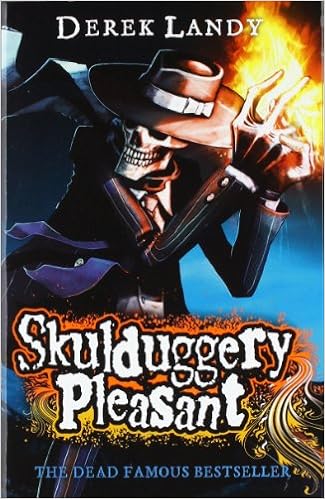
Skullduggery Pleasant by Derek Landy


Uncle Gordon has suddenly passed away and Stephanie is left as his only heir. But soon, she realizes that things may not be quite what they seem. With the help of an undead skeleton detective names Skullduggery Pleasant, Stephanie embarks on a quest to solve the mysterious, and possibly magical, death of her uncle. 

 Landy, D. (2007). Skullduggery Pleasant. New York, NY: HarperCollins. 


  1. Evaluative Criteria
    1. Characters and Theme
      1. Readers of this fantasy book can embrace the fact that the protagonist is a female who dives into  a dark adventure; readers can then enjoy the walking, talking, crime-solving skeleton who guides her through a quest that wasn’t willingly chosen, but instead was thrown at her when her Uncle suddenly dies.
      2. Theme is also a critical criteria of this fantasy book, even though it is the typical fantasy theme: good must triumph over evil. Stephanie and Skullduggery Pleasant are the good guys trying to prevent the bad guys, including Serpine, from unleashing evil upon the world. In the end, Stephanie and Skullduggery survive their adventure and prevail.

The Graveyard Book by Neil Gaiman


Bod was born to change the world, but when he toddled into a graveyard after the man Jack kills his parents and sister, his world begins to change first. He is taken in by the ghosts of the grave and raised in the ways of the undead. The skills he learns are soon put to the test when he learns that the man Jack is still searching for him and will go to the end of the undead earth to capture him and avoid the prophecy from coming to fruition. 


 Gaiman, N., & McKean, D. (2008). The Graveyard book. New York, NY: HarperCollins. 


  1. Evaluation Criteria
    1. Setting and Theme
      1. The setting of this fantasy novel is central to every element of the story: the graveyard. Every detail of the graveyard is mapped out for the reader from the moment baby Bod toddles into at. As the seasons change, the leaves fall in the graveyard and the snow begins to fall. The condition of each gravestones are revealed and the changing times outside of the suspended reality of the graveyard, all helping the reader “...see, hear, and feel the setting as they read the description.”
      2. The classic themes of good versus evil and good always wins drives the plot of this fantasy novel. The book begins with great evil: the man Jack is killing Bod’s family. But, good prevails and Bod is saved by the souls in the graveyard. He is further protected and raised by them until he is a young man. Despite the fact that the man Jack and his group of the Jack of All Trades is pursuing him to prevent the demise of their own evil group, goodness rises above and Bod, along with the help of others, is able to defeat the evil that has been chasing him his entire life.


Gregor the Overlander by Suzanne Collins


Life is rough for Gregor and his suddenly fatherless family. In the midst of doing laundry, both he and his sister, Boots, are sucked into the Underland, a world of giant, evil rats and bats that bond with humans for life. When the people of the Underland realize that an ancient prophecy brought Gregor to them, they convince him that he must take on the journey, which to his surprise, could also bring back his long-lost father.


 Collins, S. (2003). Gregor the Overlander. New York, NY: Scholastic. 


  1. Evaluation Criteria
    1. Characters and Plot
      1. The characters within the novel are easy to identify with as Gregor is an eleven-year-old boy who’s father disappeared and who is left to tend for his little sister Boots, and his elderly grandmother while his mom works to care for the family. Readers will not only “...feel a kinship” with Gregor, but they will also sympathize with the people of the Underland, who look different than humans above ground, are still filled with the same emotions and concerns as the readers. The reader “care[s] about what happens to them” as they are pushed into battle by giant rats and sent on a journey that could potentially save their world’s existence.
      2. Along with the characters, Gregor also fits the criteria of a fantasy book because of the plot that focuses on two epic journey’s: one to the Underland when Gregor and his sister fall down the dryer vent and the second being the journey with the Underlanders to fulfill the prophecy to save their lives. On the quest they encounter great danger and reluctant participants, but good prevails despite a great plot twist which turns someone who was supposed to be good, into the enemy.


    Lego Gregor Book Report

Thursday, October 22, 2015

Good Masters! Sweet Ladies! Voices from a Medieval Village


Filled with the stories of Medieval life from a youth's perspective, the monologues and dialogues of such characters as Otho, the miller's son, Simon, the knight's son, and Constance, the pilgrim, reveal the harsh realities of life during this time period by not only creating characters who readers can connect to, but who also teach the reader about a time period that they may not be familiar. Filled with sadness, joy, dishonesty, and pride, this unique collection of poems will intrigue any reader who picks it up.


Schlitz, L., & Byrd, R. (2007). Good masters! sweet ladies!: Voices from a medieval village.
Cambridge, MA: Candlewick Press.


--------------------------------------------------------------------------------------------------------------------------


The feudal system, knights, beggars, and millers, and all of the characters of a Medieval village are brought to life in a poetic form, both monologues and a few dialogues, to reveal the realities of the time period. Written to help the students at her school dive deeper into the realities of the Middle Ages through performance, the stories of the youth of the time period both show the truth of the times, such as lack of food, the control of the Catholic Church, and the different levels of livelihood. Spoken with honesty, such stories as Taggot, the blacksmith’s daughter, who dreams of being the subject of a young man’s affection, also must face her own insecurities as being “Big and ugly and shy in the bargain.” Racial tension and stereotypes are addressed in the story of Jacob Ben Salomon, the moneylender’s son, and Petronella, the merchant's daughter. Jacob is Jewish, and because of that, he is shunned and has rocks thrown at him. Petronella knows this, but sees that she is also a kind person and he isn’t any different. After certain monologues, Schlitz provides a little background on certain aspects of Medieval life, such as the history of falconry and the three-field system that was used for raising crops. Historical texts can sometimes be daunting and dry, but Schlitz engages the audience through the eyes on fictional young people to reveal the harsh truths of a very tumultuous time period. To enhance the information provided, Robert Byrd’s simple, yet informational illustrations enhance the reality of the “Medieval Manor” that Schlitz uses as her vehicle for the information. All combined, the unique blended genre of poetry and history will grab the reader’s attention and carry them through a journey of the Middle Ages.


Lesson Plan

Sunday, October 18, 2015

The Watsons go to Birmingham--1963 by Christoper Paul Curtis


It was always cold in Flint, Michigan and Byron Watson was always getting into trouble. Kenny, Byron’s little brother, wasn’t the most popular kid in school and often suffered the wrath of bullies, his brother being one of them. Despite all the warnings and punishments, Byron just couldn’t seem to stay out of trouble. As a last resort, his mom and dad decided to drive across the country to Birmingham, Alabama to  leave Byron with his grandmother in hopes that he could find the straight and narrow. But, with the South reeling from the strain of segregation and racism, their trip is rocked by an act of anger and evil that nearly destroys the Watson family and forces Kenny to deal with the ugliness of the world at this time.


Curtis, C. (1995). The Watsons go to Birmingham--1963. New York, NY: Delacorte Press.

----------------------------------------------------------------------------------------------------------------------------------
Assignment #4 - Historical Fiction Reviews


It was always cold in Flint, Michigan and Byron Watson was always getting into trouble. Kenny, Byron’s little brother, wasn’t the most popular kid in school and often suffered the wrath of bullies, his brother being one of them. Despite all the warnings and punishments, Byron just couldn’t seem to stay out of trouble. As a last resort, his mom and dad decided to drive across the country to Birmingham, Alabama to  leave Byron with his grandmother in hopes that he could find the straight and narrow. In 1963, the United States was being torn at the seams by segregation and racism. Until the Watsons arrived there, Byron, Kenny, and their younger sister Joetta, had never experienced the level of hate present in the South. Before they can even get accustomed to the heat in Birmingham, their family is rocked by an act of terror at the local church on a Sunday morning. This story will resonate with younger audiences as they see a reflection of their own family's ups and downs, as well as the anger and confusion of experiencing something that they cannot truly understand. Readers of historical fiction will appreciate the true depiction of family life during this tumultuous time period of American history, as well as the ugliness of segregation in the South.

Trailer for the movie adaptation.


Tuesday, October 13, 2015

Timmy Failure: Mistakes Were Made by Stephen Pastis


Despite being a pretty mediocre detective, Timmy, with his polar bear side kick, are bound and determined to find the principal's missing globe. With all the obvious clues, but lacking real detective abilities, Timmy continually misses the mark. 


Pastis, S. (2014). Timmy failure: Now look what you’ve done. NY: Candlewick Press.


    1. Evaluative Criteria
      1. Style and character are the criteria for contemporary realistic fiction that this novel meets. Written in first person and in a journal format, the reader is drawn into and through the journey’s of Timmy solving the mystery of the missing globe. Along with the diary format, picture are also included. These pictures look as if a young child has drawn them, further connecting the reader and Timmy. Timmy’s imagination drives the humorous tone of the novel. Along with the unique style, Timmy as a character is easy to connect with as a young reader. He has a false sense of self and ability, something which young children struggle to recognize, but his ability to use his imagination keeps them entangled in his crime solving web.

How to draw Timmy Failure and his friends.


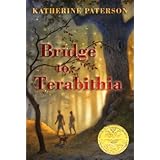
Bridge to Terabithia by Katherine Paterson


Jess just wants to be the fastest kid int he 5th grade, but Leslie prevents that dream from coming true. But, despite the heartbreak, Jess and Leslie become the best of friends, teaching each other so much about strength and friendship. Their imagination takes them to great places, but it also leads to tragedy and force Jess to figure out how to move on.


 Paterson, K., & Diamond, D. (1977). Bridge to Terabithia. New York, NY: T.Y. Crowell.


  1. Evaluation Criteria
    1. In this novel, theme and gender are the dominate criteria. Despite the heartbreaking loss in the book, the positive theme of friendship drives the novel and and helps the characters "have a personal resonance for the child reader in a way that is meaningful and worthwhile." Also, although Leslie, who is a central character, dies, her strong qualities and incredible courage leave a huge impression on Jess. This puts a female character in a dominate role, which is a contemporary depiction of gender roles. Along with this strong female, we also see a male character struggle with his emotions in a very outward way.

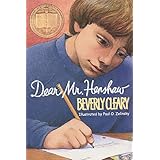
Dear Mr. Henshaw by Beverly Cleary


Heavy with the emotions of his parents divorcing and starting at a new school, Leigh Botts writes letters to his favorite author, as well as keeps a diary, to work through his feelings and figure out his new path in life. Through the ups and downs, including a father who struggles with staying connected, Leigh soon learns that his problems aren't the biggest in the world (and maybe he will never know who is stealing his lunch). 


 Cleary, B., & Zelinsky, P. (1983). Dear Mr. Henshaw. New York, NY: W. Morrow. 


  1. Evaluation Criteria
    1. Style and characters are how this novel meets the criteria for a contemporary piece of realistic fiction. This novel transitions smoothly between first person letters written to an author and first person diary entries. Because of the plot of the book, which revolves around a child's admiration of an author and their struggle to deal with the great changes in their life, including the split of his parents, both personal letters and journal entries will make an easy connection with the audience. Leigh Botts' situation as a child in the middle of a divorce, being the new kid in school, and struggling to cope are all topics that many children can relate to and feel the struggle that he feels. He is a very dynamic character who grows from an angry young man to an understanding and caring person who just happens to be suffering from an unfortunate life event.

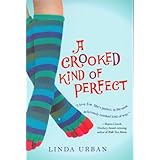
A Crooked Kind of Perfect by Linda Urban


All Zoe ever wanted was to play the piano, which of course would lead to playing at Carnegie Hall. But instead, she gets an organ from her father, who suffers from an anxiety disorder and doesn't leave home much. Her teacher sees her talent and enters her into a recital where she shows her new talent. Gaining friends along the way, Zoe learns that even with a path is changed, the journey down the path is what makes the end so sweet. 


 Urban, L. (2009). A crooked kind of perfect. Boston, MA: Sandpiper.


  1. Evaluation Criteria
    1. Gender and culture, as well as characters, are two criteria of contemporary realistic fiction for this novel. Zoe Elias is the opposite of traditional female characters: she is not only the protagonist in the piece, but she is also supported by male figures who experiences a weakness that wasn’t typically accepted in the past. Her father is the less dominant parent figure due to a social anxiety disorder that he suffers from. Along with  him, Wheeler, who seems like the tough guy at school, is able to show is more vulnerable side due to his parent’s divorce and lack of a father at home. These same characteristics produce unique characters that young readers can identify with, as well as see the “emotional growth” of all the characters involved.

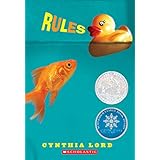
Rules by Cynthia Lord


Catherine just wants to be normal and for her brother, David, to follow rules like everyone else does. She feels weighed down by the fact that her brother is autistic, constantly fearing that he will embarrass her. But, through and unlikely friendship that is made at her brother's therapy sessions, Catherine learns that everyone is different and that learning to accept people's differences can be a pretty awesome thing. 


 Lord, C. (2006). Rules. New York, NY: Scholastic Press.


  1. Evaluation Criteria
This novel meets the criteria for contemporary realistic fiction through theme and setting. The “search for an independent identity” is exemplified in the complex relationship between Catherine and her brother, David. This search connects with young readers as many are experiencing the same quest. She wants so much to be separate from David’s complications, but realizes that he is PART of her identity. In regards to setting, Rules is set in an average town on a quiet, suburban street where kids meet for the bus together, swim in the lake during the summer, and become fearful of school dances. Young readers can both identify the characters as realistic in their setting, as well as transcend the setting to see themselves in the same situations.


Out of My Mind by Sharon M. Draper


 Melody just wants to say all of the thing she has swimming around in her head like all the other people around her. After years of being so very different and alone, she is finally released from her own mind via new technology. But, just when she is finally being accepted for who she is, the harsh realities of the world knock her back down. 


Draper, S. (2010). Out of my mind. New York, NY: Atheneum Books for Young Readers. 


  1. Evaluation Criteria
    1. This novel meets the criteria for contemporary realistic fiction through the characters and plot. Melody is a non-traditional character who is not only female, but also has a disability. She is a female heroine and the underdog, both qualities that make the reader cheer her on through all of her struggles. As the reader travels through her trials and tribulations, the reader expects her rise to stardom and her new voice to take her to the top: the big quiz bowl. But, the realities of a society that doesn’t embrace different rears its ugly head, throwing the reader down a strange, new path. The plot also embraced the “hopeful, if not always happy” resolution of contemporary realistic fiction as Melody doesn’t get the result the reader hoped, but she does learn to live with what she has.

Wednesday, September 9, 2015

Primates by Jim Ottaviani and Maris Wicks


Informational text AND graphic novel? What better way to learn about three amazing women who, without formal degrees or really any training, paved the way for female scientific researchers and the study of primates. Jane Goodall, Dianne  Fossey, and Birute Galdikas's stories of tromping through jungles and closely observing their respective primates is both informational and appealing as presented. 

Ottaviani, J. (2013). Primates. NY: FirstSecond.

  1. Evaluation Criteria
    1. Style
      1. Presenting an informational text in the form of a graphic novel is incredibly appealing to young readers. It is sort of like combining a great picture book with a very well written non-fiction book. Beyond the author’s own style that is shown in regards to “distinctiveness in the presentation of the information,” the voice and attitude of the three women that the book tells the story of is very well presented. Their passion and strength is felt as the reader sees the comic book like images and reads the powerful words of their work. As the afterword stated, most of this book is true, but some is made up or altered, creating the fictional characteristics that help the book flow and help intrigue the reader to pick it up and continue to read it. This book is a great example of the “quality nonfiction that is just a worthwhile as a experience as a good novel.”


Tuesday, September 8, 2015

We are the Ship by Kadir Nelson


The history of the Negro Baseball league is sometimes trumped by its culmination in the form of Jackie Robinson. This book starts from the beginning of the league, providing quotes and commentary from players during the time to tell the story of the hardships of playing "America's sport" in a time when America was very much divided. Using powerful images to reinforce the emotions and situations of the time, this book reveals details of a very strained period in history through the love of baseball. 

Nelson, K. (2008). We are the ship. NY: Hyperion.

  1. Evaluation Criteria
    1. Organization
      1. This informational book is organized in “innings,” which both works chronologically for the information, but it also provides an extensive index if the reader is using the text more like an encyclopedia and simple wants to find information about one person or one event. Along with the main chapter titles, or “innings,” each chapter has a subtitle that briefly explains the type of information that is going to be included in that chapter. These “reference aides” let the reader both go in order of chapters, as well as jump around. Overall the organization “help[s] the reader to pick and choose what she or he needs;” in addition, there is a “clear sequence to the information” about the negro baseball league that will guide the reader through the book.