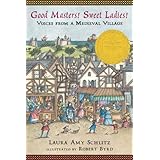
Filled with the stories of Medieval life from a youth's perspective, the monologues and dialogues of such characters as Otho, the miller's son, Simon, the knight's son, and Constance, the pilgrim, reveal the harsh realities of life during this time period by not only creating characters who readers can connect to, but who also teach the reader about a time period that they may not be familiar. Filled with sadness, joy, dishonesty, and pride, this unique collection of poems will intrigue any reader who picks it up.
Schlitz, L., & Byrd, R. (2007). Good masters! sweet ladies!: Voices from a medieval village.
Cambridge, MA: Candlewick Press.--------------------------------------------------------------------------------------------------------------------------
The feudal system, knights, beggars, and millers, and all of the characters of a Medieval village are brought to life in a poetic form, both monologues and a few dialogues, to reveal the realities of the time period. Written to help the students at her school dive deeper into the realities of the Middle Ages through performance, the stories of the youth of the time period both show the truth of the times, such as lack of food, the control of the Catholic Church, and the different levels of livelihood. Spoken with honesty, such stories as Taggot, the blacksmith’s daughter, who dreams of being the subject of a young man’s affection, also must face her own insecurities as being “Big and ugly and shy in the bargain.” Racial tension and stereotypes are addressed in the story of Jacob Ben Salomon, the moneylender’s son, and Petronella, the merchant's daughter. Jacob is Jewish, and because of that, he is shunned and has rocks thrown at him. Petronella knows this, but sees that she is also a kind person and he isn’t any different. After certain monologues, Schlitz provides a little background on certain aspects of Medieval life, such as the history of falconry and the three-field system that was used for raising crops. Historical texts can sometimes be daunting and dry, but Schlitz engages the audience through the eyes on fictional young people to reveal the harsh truths of a very tumultuous time period. To enhance the information provided, Robert Byrd’s simple, yet informational illustrations enhance the reality of the “Medieval Manor” that Schlitz uses as her vehicle for the information. All combined, the unique blended genre of poetry and history will grab the reader’s attention and carry them through a journey of the Middle Ages.
Lesson Plan
Lesson Plan

No comments:
Post a Comment