Monday, August 31, 2015

The Three Pigs by David Wiesner


Although this book starts with the classic tale of the three little pigs begin terrorized by the bad wolf, a quick plot twist releases the pigs from their pages and sends them on an adventure through other classics. They bring characters out of the books they visit and end their journey back in the classic we know: all snuggled in safe in the house made of bricks.


  1. Visual Element
    1. Texture
      1. When the book begins in classic “Three little pig” form, the illustrations are classic and 2D. But, when the pigs break loose from their pages, their texture is revealed and they suddenly look like realistic pigs. This same scenario happens when they enter classic tales and then other characters exit. This helps the reader also feel the sense of adventure and imagination needed to break free from the normal stories.
  2. Evaluative Criteria
    1. Plot
      1. The plot of this story begins like the one we have all heard as kids, but quickly there is a plot twist when the pigs break free from their pages and roam the worlds of other classic books. The use of the paper airplane guides the non-linear plot from selection to selection, and finally back to their home. The plot is both familiar and not familiar, which engages the reader and sparks their imagination and drive to continue reading.


Wiesner, D. (2001). The three little pigs. NY: Clarion

David Wiesner Biography/Book Review


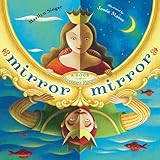
Mirror, Mirror by Marilyn Singer


Is there always only one side to a story? In this beautifully illustrated text, an alternate view on classic fairy tales is revealed in verse form alongside the original point of view. From the sadness of the evil Stepsisters in Cinderella as they watch from the corner of the ball, to the Bears being the ones violated by Goldilocks. This book puts a unique twist on old classics.


  1. Visual Element
    1. Composition
      1. Line, shape, color, and texture come together in these beautiful illustrations that bring the concept of reverse verse to life. Each illustration is neatly divide into four quadrants or in halves that depict both sides of the story in a way that is not only appealing to the eye, but also reiterates the duality of the original fairy tale. In “Cinderella’s Double Life,” the lightness and darkness in each side of the illustration reinforce the positive and negative feelings of the moments. Also, the transition from each picture using continual lines makes the two starkly different images flow together.
  2. Evaluative Criteria
    1. Illustrations
      1. Because this book doesn’t follow a continuous plot line, but instead uses each pair of pages to depict a single story in two versions attached to a double image, the illustrations not only complement the reverse versus, but also can be looked at without the poems and the reader can still understand the duality of these classic fairy tales. Readers can immediately see both sides of the story, as well as quickly recognize the classic elements of the tales they have read or heard before. In addition to the full illustrations, the use of red and blue text for the poems is an additional illustration, symbolizing the more positive or usual side of the story in contrast to the heavier, darker side of the story. Finally, the individual illustration at the bottom of the text pages uses one significant image from the classic tale to sort of summarize the text and focus the imagery.


Singer, M. (2010). Mirror, Mirror. NY: Dutton.

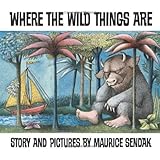
Where the Wild Things Are by Maurice Sendak


After making his mother upset, Max is sent to his room without dinner. As he sits alone, his room transforms into a wild forest and he travels to the place where the Wild Things are. He stomps, and romps, and causes a ruckus as the King of the Wild Things. But, he misses the love of his mom and the taste of her food. His anger turns to sadness, and his imagination brings him back home to his comfy room and warm food.


    1. Composition
      1. The author’s use of line, color, and texture bring the story to life and reflect the movement from anger, to excitement, to sadness, and finally to happiness as Max travels. They work together create a realistic journey through the forest and ocean, as well as rambunctious interactions between Max and the Wild Things. Although the Wild Things are real things, the illustrations reveal their individual characters in regards to textures of scales and feathers.
  1. Evaluative Criteria
    1. Character
      1. Sendak states that the book touches the “...vagrant child that lurks in the heart of all of us.” Max is an incredibly relatable character for children. He just wants to be rambunctious and wild, but his mother doesn’t have the patience for it and punishes him by sending him to his room. When he is left there in solitude, his anger makes him travel far away to a place where HE gets to make the rules. Despite all the fun, he just wants to the love of his mom and some tasty food. This is the circle that represent the child-parent relationship.

Sendak, M. (1963). Where the wild things are. NY: Harper Collins.

This is Not My Hat by Jon Klassen


While taking a leisurely nap, a big fish has his hate stolen by a little fish, who tries to quickly escapt the scene and hid in tall grass. He mistakenly thinks that he won’t be caught because the crab won’t tell on him and the big fish won’t know where to go. In the end, his sneakiness doesn’t lead to the end he had hoped.


  1. Visual Element
    1. Shape
      1. The dominant shape in this story is an oval. The fish are different size ovals, all of the plants are ovals, and even the crab is sort of oval shaped. Shapes create movement , as stated in the textbook. Throughout the course of the book, the little fish is moving away from the big fish and his body shape of an oval expresses that. The big fish, after realizing his hat is missing, also has an oval shaped body and moves in the same direction. the plants ovals are pointing in different directions, mimicking the movement of underwater plants as the current moves. The shape movement also mirrors the movement of the plot.
  2. Evaluative Element
    1. Style
      1. The repetitive wording of the text creates a distinct style and attitude. The small fish seems cocky, yet intelligent. The illustrations create even more of a distinct style. The black background represents the depths of the ocean, but based on the plants the little fish goes into, the ocean should be much brighter. I believe the author choose black to symbolize the negative action of the fish. Also, the author’s use of shapes reveal a unique style. Even more unique is the author’s choice to not have the large fish and the crab speak, but instead to reveal their conversations and emotions through the illustrations, thus allowing the reader to make inferences.

Klassen, J. (2012). This is not my hat. Boston, MA: Candlewick.

Booktrailer


Sunday, August 30, 2015

The Paper Bag Princess


Ready to marry her prince Ronald and decked in her beautiful things, Princess Elizabeth's world is turned upside down when a dragon destroys everything, forcing her to go after him in just a paper bag dress. After exhausting the dragon, she frees her prince only to realize that he isn't such a great guy and maybe she wasn't meant to be a stereotypical princess. 

  1. Visual Element
    1. Line
      1. The lines of the text both create movement and shape, but also reflect the empowerment of the princess as she progresses through the tale. The smoke always left by the dragon, as well as the lines of the paths, flows in the direction of his exit, creating a line for the princess to follow. Many of the shapes are straight edges and all of them are very clear, symbolizing the “straight-edged” princess and the clear path she thought she was taking. But the crooked dragon took all of these things away, revealing her true self. Elizabeth becomes a strong character with strong lines and leaves the prince down a straight path towards a setting sun.
  2. Evaluative Criteria
    1. Theme
      1. As stating in the textbook, “kids are generally rather resistant to sermonizing…” when it comes to theme. This picture book doesn’t over-embellish the theme of individuality or not being suppressed by a man, but instead it allows children to see how a young girl can move from inside to outside of the box. Children will recognize the stereotypical princess-marrying-a-prince, but they will also recognize the dragon as a hero to Elizabeth by showing her what is really important in life and how to embrace herself.

Munsch, R. (2012). The paperbag princess. NY: Annick Press.

Comparison Text: Non-Traditional Princess Stories
Cole, Babette.
Princess Smartypants. 1987.Not wishing to marry any of her royal suitors, Princess Smartypants devises difficult tasks at which they all fail, until the multitalented Prince Swashbuckle appears.[Education Storage SE. C6742PS1987, Center for Children’s Books SE. C6742PS1987]


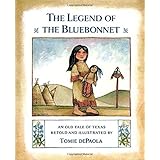
The Legend of the Bluebonnet by Tomie dePaola


When the Comanche tribe feels like they can never bring rain back to their lands, The Great Spirits tells his people that they must sacrifice a valued possession among their people to end the famine that has taken many, including family of one little girl with a very precious doll. This little girl makes a great sacrifice for her people and brings happiness and prosperity back to their land. 

  1. Visual Element
    1. Texture
      1. To enhance the realistic qualities of this text, the illustrator embraces the textures of the Comanche’s things, as well as the bluebonnets. The goal of folklore is to use fantasy like elements to explain something very true and realistic. This is done in the story by making the Comanche garb and accessories look as if they are the true relics, as well as making the hills of bluebonnets look like the hills of Central Texas today. This quality makes folklore feel very real.
  2. Evaluative Criteria
    1. Cultural Markers
      1. This text embraces the beliefs and culture of the Comanche people, as well as the folklore behind the bluebonnet in Texas. Most importantly, dePaola based this story on research of both the folklore of the Comanche and their cultural beliefs, not relying on stereotypes or generalizations. Children can not only read a tale about the creation of a beloved flower, but also learn about the belief in Spirits and sacrifice for the Comanche people. The text of the story also reflects the language of the Comanche. Because their language was not English, the cadence of the language used sounds broke as if English was their second language.

dePaola, T. (1983). The legend of the bluebonnet. NY: Putnam.

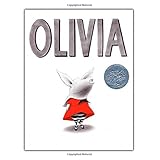
Olivia by Ian Falconer


A little pig with BIG dreams, Olivia describes her daily trials and adventures as she learns about the world around her and, more importantly, who she is and why she is so unique. From her morning routine, to learning to build magnificent sand castles, to mastering the skill of persuasion when it comes to how many books will be read at bedtime, Olivia embodies the typical child with the atypical dreams.

  1. Visual Element
    1. Color
      1. Black, white, grey, and red are the colors of Olivia. These colors exemplify the character of Olivia as a young girl who stands out from the crowd in so many ways. Children not only recognize this in the words of the story, but also with the pop of red on Olivia in the different scenes. She is a fiery girl who “wears people out.”
  2. Evaluative Criteria
    1. Character
      1. Olivia is a beloved character because she is the epitome of a young girl/child. She can’t sit still, she has to try everything, and she hates naps. She dreams of being a ballerina and strives to be great at everything she does. Like the textbook states, she is an “individual with a strong sense of self, and a unique way of seeing the world and expressing themselves.”

Falconer, I. (2009). Olivia. NY:Atheneum.

My Teacher is a Monster by Peter Brown


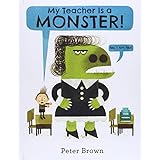
A classic tale turned into a cute book, My Teacher is a Monster follows Robert, a student of Ms. Kirby's, who thinks that she is such a terrible monster of a teacher, like so many other young students. But, after a routine trip to the park, Robert's perception of Ms. Kirby changes. 


  1. Visual Element
    1. Color
      1. Throughout the text, different shades of green dominate the color scheme. As stated in the textbook, shades of green represent, which is a central location in the text. Both Ms. Kirby and Robert share the same favorite place: the lush, green, park. Besides nature, green also symbolizes youth. Robert’s youth blinds him to the reality of Ms. Kirby and turns her into a monster, a childhood belief,  that she is not. As Robert and Ms. Kirby learn about one another, she begins to change into a human form, losing her green, symbolic look.
  2. Evaluative Criteria
    1. Plot
      1. This text follows the basic plot structure which is: exposition, rising action, climax, falling action, and resolution. Because of this, young readers are able to easily follow the story of Ms. Kirby and Robert. Also, the idea that a young child things their teacher is horrible is a classic situation. But, what makes this story more than the typical plot is both the realization that a teacher and student can share a favorite something, but also the fact that Robert recognizes that she isn’t monster, but she can still ACT like one sometimes. The illustrations drive the progression of the plot by moving from dark to lighter colors, as well as seeing Ms. Kirby transform from the ugly, green monster, to a human-like character.


Brown, P. (2014). My teacher is a monster! New York, New York: Little, Brown and Company. 


YouTube Read Aloud