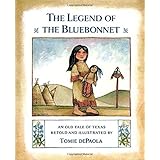
When the Comanche tribe feels like they can never bring rain back to their lands, The Great Spirits tells his people that they must sacrifice a valued possession among their people to end the famine that has taken many, including family of one little girl with a very precious doll. This little girl makes a great sacrifice for her people and brings happiness and prosperity back to their land.
- Visual Element
- Texture
- To enhance the realistic qualities of this text, the illustrator embraces the textures of the Comanche’s things, as well as the bluebonnets. The goal of folklore is to use fantasy like elements to explain something very true and realistic. This is done in the story by making the Comanche garb and accessories look as if they are the true relics, as well as making the hills of bluebonnets look like the hills of Central Texas today. This quality makes folklore feel very real.
- Evaluative Criteria
- Cultural Markers
- This text embraces the beliefs and culture of the Comanche people, as well as the folklore behind the bluebonnet in Texas. Most importantly, dePaola based this story on research of both the folklore of the Comanche and their cultural beliefs, not relying on stereotypes or generalizations. Children can not only read a tale about the creation of a beloved flower, but also learn about the belief in Spirits and sacrifice for the Comanche people. The text of the story also reflects the language of the Comanche. Because their language was not English, the cadence of the language used sounds broke as if English was their second language.
dePaola, T. (1983). The legend of the bluebonnet. NY: Putnam.

No comments:
Post a Comment