- Visual Element
- Color
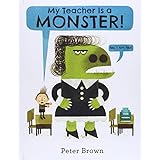
- Throughout the text, different shades of green dominate the color scheme. As stated in the textbook, shades of green represent, which is a central location in the text. Both Ms. Kirby and Robert share the same favorite place: the lush, green, park. Besides nature, green also symbolizes youth. Robert’s youth blinds him to the reality of Ms. Kirby and turns her into a monster, a childhood belief, that she is not. As Robert and Ms. Kirby learn about one another, she begins to change into a human form, losing her green, symbolic look.
- Evaluative Criteria
- Plot
- This text follows the basic plot structure which is: exposition, rising action, climax, falling action, and resolution. Because of this, young readers are able to easily follow the story of Ms. Kirby and Robert. Also, the idea that a young child things their teacher is horrible is a classic situation. But, what makes this story more than the typical plot is both the realization that a teacher and student can share a favorite something, but also the fact that Robert recognizes that she isn’t monster, but she can still ACT like one sometimes. The illustrations drive the progression of the plot by moving from dark to lighter colors, as well as seeing Ms. Kirby transform from the ugly, green monster, to a human-like character.
Brown, P. (2014). My teacher is a monster! New York, New York: Little, Brown and Company.
YouTube Read Aloud

No comments:
Post a Comment